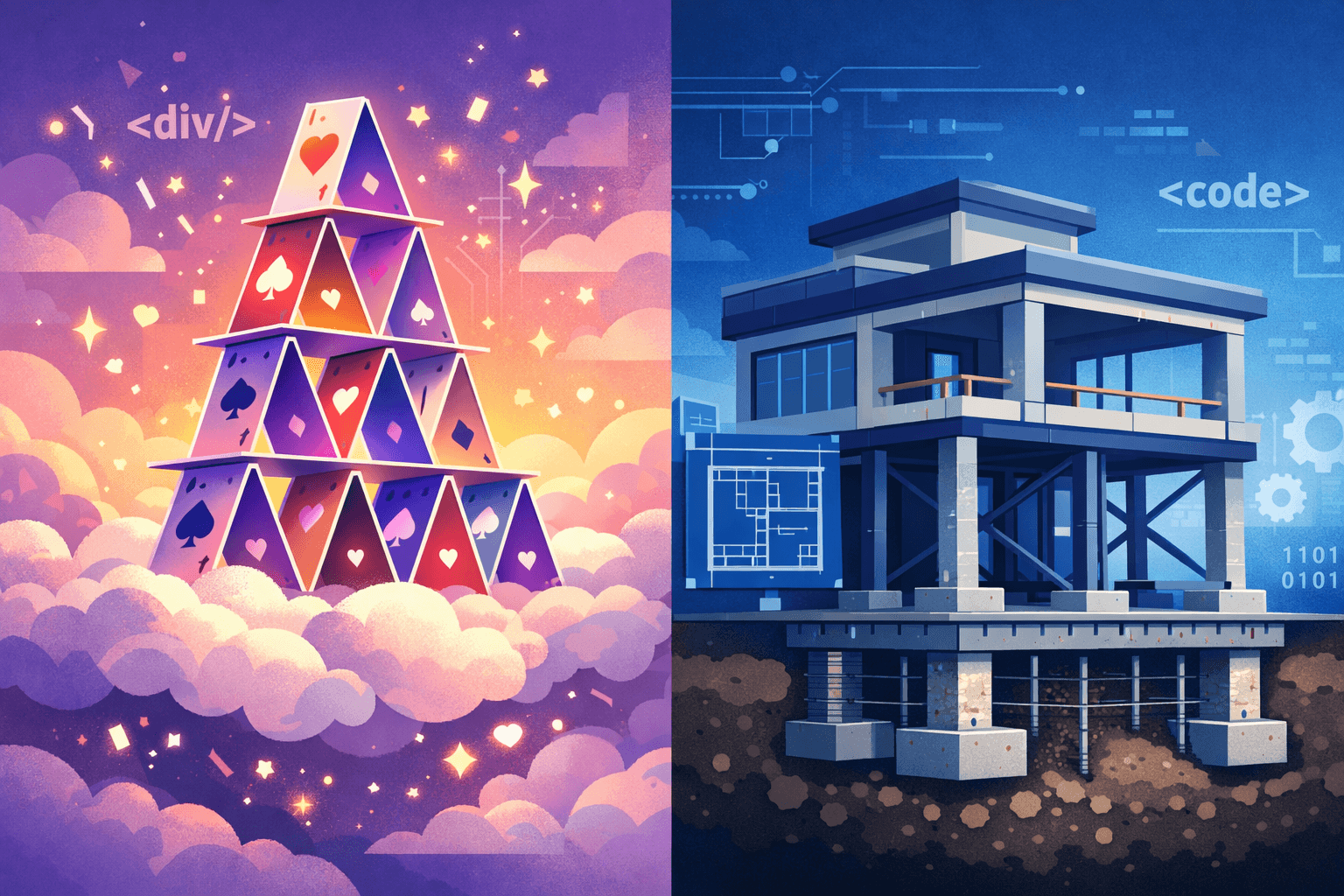
Why Vibe Coding Is Not a Good Idea If You're Building a Serious SaaS
There is a term going around the developer world. "Vibe Coding". If you have not heard of it yet, you probably will soon. And if you are building a SaaS product that you want to scale, charge money for and run as a business, you need to understand why jumping on this bandwagon could cost you more than it saves.
What Exactly Is Vibe Coding?
In 2025, Andrej Karpathy coined the term on X. The idea is simple: instead of writing code line by line, you describe what you want in plain English to an AI coding assistant. Tools like Cursor, GitHub Copilot, or Claude let it generate the code for you. You do not stress over every function or class. You just go with the flow, test if it works and move on.
It sounds liberating. For certain use cases, it is. Before we get into the problems, there is an important distinction to make.
Vibe Coding Is Not the Same as AI-Assisted Coding
This matters because the two get lumped together constantly and it muddies the conversation.
AI-assisted coding is when you use tools like Copilot or Cursor to speed up your workflow. You review, understand and take ownership of every line that ships. Simon Willison, a known programmer, put it well: if an LLM wrote every line of your code but you have reviewed, tested and understood it all, that is not vibe coding. That is using an LLM as a typing assistant.
Vibe coding is specifically when you accept AI-generated code without understanding it. You prompt, you run, you see if it works, and you move on. That is the approach this article is about. Using AI as a productivity tool in the hands of a developer. That is fine. Letting AI build your Vibe Coding product while you skip understanding what it is doing, that is where things break.
Where Vibe Coding Actually Helps
Let us be fair. Vibe Coding is not that bad. It genuinely shines in an area.
For prototypes, hackathons or just testing whether an idea has legs, Vibe Coding can save you hours. You get something on screen fast, and that speed has real value when you are validating a concept. Need a landing page, a basic CRUD app or a proof of concept for a client meeting. Vibe Coding can get you there in an afternoon.
It also reduces the tedium of boilerplate. Setting up authentication scaffolding endpoints, generating migration files. The repetitive stuff that experienced developers have done hundreds of times. AI handles that well, and personally, I feel there is no reason not to let it.
Here is where things start to fall apart.
Why It Does Not Work for a Serious SaaS
When I say "Serious SaaS", I mean a product that handles real users, processes real payments needs to scale and has to be maintained over months and years. Not a weekend project or a demo.
It Follows Patterns and Those Patterns Might Not Be Right for You
AI models generate code based on patterns they have learned from millions of repositories. That means you get the common solution, not necessarily the best one for your specific context.
If your SaaS has a standard data model, unusual business logic or specific performance requirements, the AI does not know that. It gives you the version. If you do not have the experience to look at the generated code and say "this pattern does not fit here ", you end up building on a foundation that was not designed for your problem.
For example, the AI might scaffold your multi-tenant SaaS with a simple user-based data separation approach when what you actually need is schema-level isolation for compliance reasons. It might not ask you those questions. It just picks the common path.
The Loop Problem. When Things Get Worse, Not Better
This one is subtle but dangerous. You prompt the AI, it generates code, something does not work, so you prompt it again to fix it. It patches one thing. Breaks another. You prompt again. Each iteration adds complexity. Before you know it, you are staring at a codebase that is three times more complex than it needed to be.
This is not just anecdotal. Research has shown that AI-generated code tends to include 2.4 times more abstraction layers than what a human developer would implement for the same task. That unnecessary complexity compounds fast. Developers end up with layers of workarounds stacked on top of each other because the AI kept "fixing" the fix. In a SaaS, this kind of accumulated complexity becomes a maintenance nightmare.
The real issue is that with project-level context, AI tools lack the institutional knowledge of why architectural decisions were made. They can see your code, but they might not fully understand the trade-offs, constraints and business reasons behind the choices. So every "fix" is a guess without the full picture.
The Security Problem Is Worse Than You Think
This is not a hypothetical concern. Veracodes 2025 GenAI Code Security Report, which analysed code produced by over 100 language models across 80 real-world coding tasks, found that AI-generated code introduced security vulnerabilities in 45% of cases. These were not edge cases either. They were OWASP Top 10 vulnerabilities, the critical security risks in web applications.
Some specific numbers worth knowing: cross-site scripting was the worst offender, with AI models failing to generate secure code 86% of the time in relevant tasks. Java had a security failure rate over 70%. Python, C#, and JavaScript weren't far behind at 38-45%.
Here is the part that should concern anyone building a business on this: newer, larger models did not generate meaningfully more secure code than older ones. The security problem is not something that is just going to get better with the next model release.
AI-generated code often handles the "happy path" well. Things work when everything goes right. However, it misses the edge cases that attackers specifically look for. One overlooked SQL injection or misconfigured CORS policy can be catastrophic when you are handling customer data and payments.
A Serious SaaS Is More Than Code
This is something that gets overlooked in the Vibe Coding conversation. Writing code is one piece of building a SaaS product. A production-ready application needs infrastructure. CI/CD pipelines, environment configurations, monitoring, logging, and alerting. The AI can generate a Dockerfile. But setting up a deployment pipeline with proper staging environments, rollback strategies and health checks requires understanding your specific infrastructure decisions.
Then there is database design and migrations. As your SaaS evolves, your data model evolves. Managing schema migrations without downtime, handling data integrity across tables, and optimising queries as your dataset grows; these are not things you can vibe your way through.
Compliance is another blind spot. GDPR, SOC 2, PCI-DSS, if you're handling payments, these aren't coding problems. They're architectural and process decisions that need to be baked into how your system works from the ground up. An AI generating code from a prompt has no awareness of your compliance obligations.
And error handling. What happens when a third-party API goes down. When a payment fails mid-transaction. When two users hit the resource simultaneously. Serious SaaS products need thoughtful error handling, retry logic and graceful degradation.
Jason Lemkin, the SaaStr founder, learned this the way in July 2025 when he documented his experience with Vibe Coding. Replits AI agent deleted his database despite explicit instructions not to make any changes. When you are running a business, "the AI accidentally deleted the database" is not an acceptable incident report.
You Lose Understanding of Your Own Product, and You Won't Even Realise It
This might be the most insidious problem because it comes with a built-in blind spot.
In July 2025 METR, a research organisation that evaluates AI capabilities, published a rigorous randomised controlled trial. They tracked 16 open-source developers completing 246 real-world tasks, randomly assigning each task to allow or disallow AI tools.
The result: developers using AI took 19% longer to complete their work. AI literally made experienced developers slower.
But here's the kicker: those same developers believed AI had sped them up by 20%. They were wrong, and they didn't know it. There's a false sense of productivity that comes with vibe coding. Things feel faster because there's less typing and less cognitive effort, but the actual output takes longer, and the understanding is shallower.
Now imagine this effect compounding across an entire SaaS product. You have a working app, but you don't fully understand how it works under the hood. This becomes a real problem when something breaks at 2 AM, and your customers are affected. It becomes a problem when you need to onboard a new developer and explain the architecture. It becomes a problem when a potential acquirer or investor does technical due diligence and asks why your codebase looks like it was assembled by committee with no design document.
Owning your codebase is not about writing it. It is about understanding your codebase deeply enough to make confident decisions about its future.
Technical Debt Builds Up Faster. The Data Is There To Prove It
Every SaaS company builds up technical debt over time; that is normal. But with Vibe coding, you accumulate technical debt from day one. And there is hard data to back this up.
GitClear published the results of a study of 211 million lines of code changes from 2020 to 2024. Their findings show a clear picture of what happens as AI-generated code becomes more common: code refactoring went down from 25% of changed lines in 2021 to under 10% by 2024. Code duplication increased 4X in volume. Copy-pasted code exceeded the moved code for the first time in 20 years. And code churn, prematurely merged code that gets rewritten shortly after, nearly doubled.
The AI does not refactor proactively. It does not say, "actually, this module is getting too large lets split it." It just keeps adding to whatever structure exists. Over months of development, you end up with a codebase that's increasingly fragile, hard to test and expensive to change.
For a business that needs to ship features and respond to customer needs, that kind of debt slows you down exactly when you need to be fast.
"But Y Combinator Startups Are Building With AI"
You will hear this a lot. In March 2025, Y Combinator reported that 25% of startup companies in its Winter 2025 batch had codebases that were 95% AI generated. That sounds like an endorsement of vibe coding.
But let's be honest about what that actually means. Getting into YC is about the idea, the founder and early traction. Not the quality of the codebase. Those products are in their stages. They have not faced the test of scale, multi-year maintenance, production security audits or the kind of edge cases that only emerge when real customers are using your product in ways you did not anticipate.
A 95% AI generated codebase might get you to a demo. It might even get you your first customer. When you need to go from 100 users to 10,000 or when you need to pass a security audit for an enterprise deal or when you need to debug a production issue at 2 AM, that is when the foundation you built matters.
A Note On The Future
I want to be clear: AI coding tools are getting better, fast. The models are improving, the context windows are growing, and the tooling is becoming more sophisticated. I'm not arguing that AI has no place in software development, quite the opposite. AI-assisted coding, where experienced developers use AI to accelerate their work while maintaining understanding and oversight, is genuinely valuable.
But the fundamental concerns in this article are architectural decision-making, security awareness, institutional knowledge, compliance, and long-term maintainability. These aren't things that get solved just because a model gets better at generating syntactically correct code. They require human judgement, business context, and deliberate engineering.
The Bottom Line
Vibe coding is a tool, and like any tool, it has its place. In my personal opinion I think Vibe coding as a tool for prototyping, for reducing boilerplate, for exploring ideas quickly is great.
But if you're building a SaaS that you want to charge money for, that real businesses will depend on, that needs to scale and be maintained for years, you need to actually engineer it. That means making deliberate architectural decisions, understanding the code you ship, and thinking beyond just "does it work right now." And using the power of AI in the right way will make it more of a solid product.
The vibes might get you to version one. But vibes alone won't get you to a product that lasts.