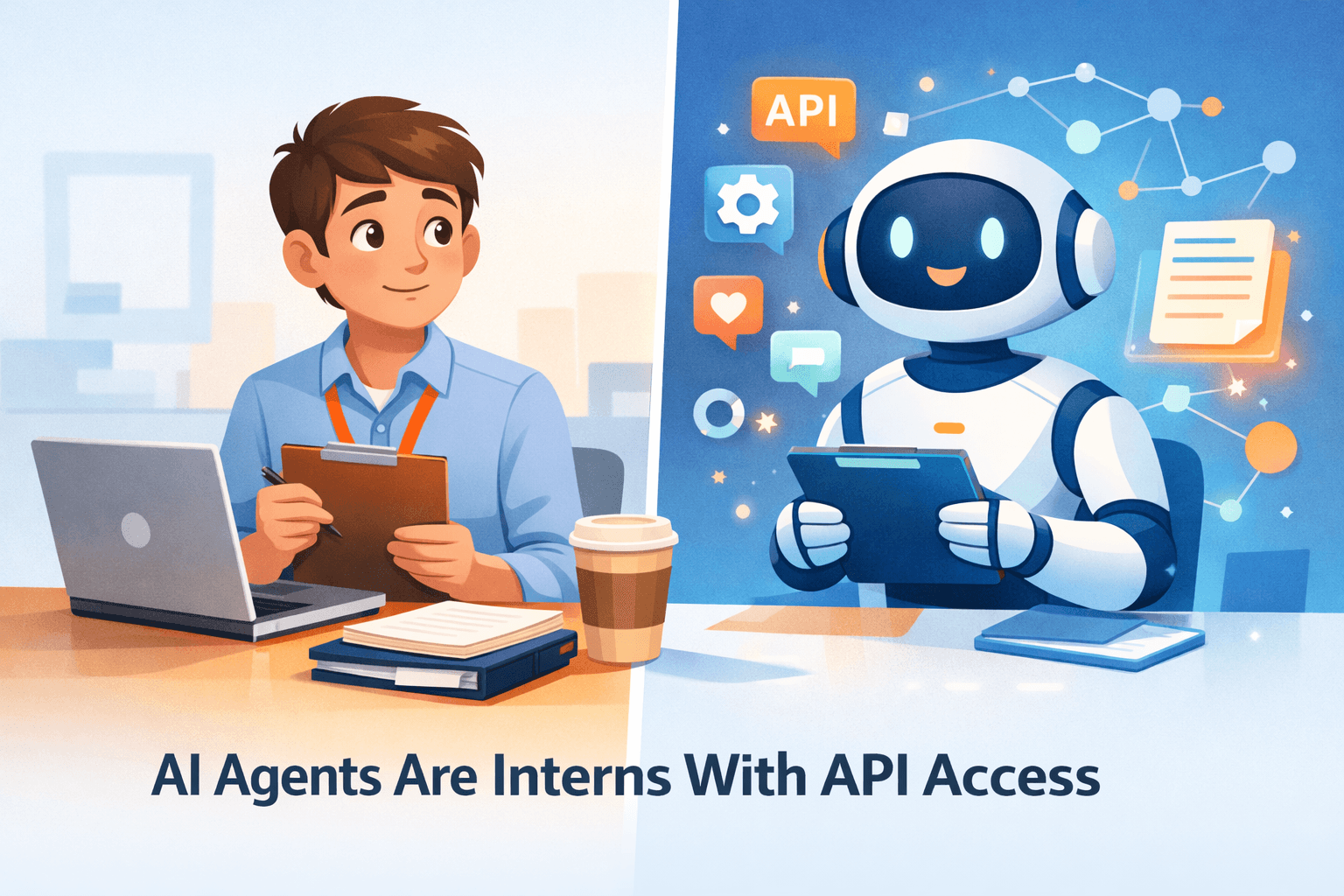
AI agents are interns with API access
Most founders are making one of two mistakes with AI agents. They either treat them like magic. Or they treat them like glorified chatbots with better branding.
Neither mental model is useful. The most practical way to understand an AI agent is this: An AI agent is an intern with API access and a context pack.
That is not a put-down. It is what makes the model useful.
A good intern can follow instructions, use tools, learn from examples, and make progress without needing constant hand-holding. But they still need direction, boundaries, and supervision. Left completely alone, they can create a lot of activity without creating the outcome you actually wanted.
AI agents are the same. They can reason through tasks. They can use tools. They can act across systems. But they still do not understand your business the way you do. They do not carry judgment and they do not own consequences. They absolutely should not be given freedom just because they sound confident.
If you start thinking about agents like interns, a lot of the confusion disappears.
Here is what that changes.
1. They can reason, but they cannot own your priorities
A capable intern can take a task, break it into steps, try a few approaches, and get somewhere useful. That is also what makes an AI agent feel impressive. You give it a goal. It plans, executes, retries and adapts. That loop is what people mean when they talk about “agentic” behavior. But founders often confuse that with judgment. That is the mistake.
Reasoning is not judgment. An agent can work through a problem. It still cannot decide what matters most to your business unless you have made that painfully clear.
Tell an agent to draft and send an email campaign, and it may do exactly that. It will not stop and say, “This should probably wait because the product is unstable and support is already overloaded.” It will optimize for the task. It will not automatically optimize for the wider business reality around the task. That is not failure, but that is the job you gave it. Interns do this too, they can execute correctly while still missing the bigger picture. So can agents.
That is why the right question is not, “Can the agent do this?” The better question is, “Should the agent be the one deciding this?”
2. Tools make them useful. Guardrails make them safe.
What makes an agent more than a chatbot is not the conversation. It is the ability to act, search the web, query a CRM, read support tickets, update a CMS, run code, call APIs, trigger workflows, write to databases, send emails and much more.
That is where the real value is. It is also where the real risk is. When founders talk about AI agents, they often focus on capability. I think that is the wrong place to focus first. The more important question is this:
What happens if the agent gets something wrong?
That is the operational question that matters. An intern with access to your systems can be incredibly helpful. They can also publish the wrong content, email the wrong list, overwrite the wrong field, or make a mistake that takes hours to unwind.
Agents are no different. This is why I do not think the interesting conversation is “Should agents have tools?” Of course they should.
The better conversation is:
- Which tools?
- With what permissions?
- Under what conditions?
- With what human checkpoints?
Most teams do not have an agent problem. They have a permissions problem. A sensible setup might look like this:
- The agent can read broadly
- It can draft freely
- It can recommend actions confidently
- It can execute low-risk actions automatically
- It must ask for approval on anything customer-facing, irreversible, or commercially sensitive
That is how you get value without creating preventable damage. Tools make agents powerful. Governance is what makes them production-safe.
3. Context is the real leverage
A lot of people still think the secret to good agent performance is choosing the right model. That matters, but it is just not the whole game.
In practice, the bigger differentiator is often the quality of the context the agent is working with. Think about how you would onboard an intern properly.
You would not just say, “Help with marketing,” and disappear.
You would give them context:
- What the business does
- Who the customer is
- What good looks like
- What bad looks like
- What tone to use
- What to escalate
- What is off-limits
- Where to find the right information
Agents need the same thing. I call this the context pack. And this is where most teams underinvest.
They connect a few tools, write a vague prompt, and expect the agent to somehow infer the business. Then they are surprised when the output is technically plausible but strategically weak. That is not an agent failure. That is a setup failure.
A strong context pack usually includes: role clarity, goals, boundaries, examples, escalation rules, reference materials, definition of success and failure.
This is also why agent skills, playbooks, and structured reference docs matter so much. They are not “nice to have.” They are the difference between an agent that feels random and one that feels genuinely useful.
The best agents are rarely the most magical. They are usually the ones who were briefed properly.
4. What founders keep getting wrong
From what I am seeing, founders tend to make the same three mistakes with agents.
Mistake 1: They delegate too much judgment
They ask the agent to decide, not just execute. They trust AI agents more than themselves.
Mistake 2: They connect too many tools too early
They chase capability before defining boundaries.
Mistake 3: They judge the setup by the demo, not by the edge cases
The happy path works. The real test is what happens when context is thin, data is messy, or the action carries risk. This is why some agent setups look impressive for ten minutes and disappointing for ten weeks.
The issue is rarely that the model “isn’t smart enough.” More often, the issue is that the business handed over too much ambiguity, too much access, and too little structure.
So what should founders do instead?
Treat agents like capable but unsupervised team members.
Not toys. Not magic. Not replacement executives.
Give them:
- clear scope
- the right tools
- strong context
- approval boundaries
- human oversight where the downside matters
That is where the real leverage is. Not in pretending the agent understands your business better than you do. But in designing a setup where it can move fast inside a system you control. That is the part too many teams skip. They focus on what the agent can do.
I think founders should focus harder on what the agent is allowed to do, what it should never do, and what it should escalate back to a human. That is what separates a useful agent from an expensive liability.
Final thought
I do think AI agents are powerful. I also think the market is currently overestimating what “can reason” really means in a business context. Agents do not replace leadership. They do not replace prioritization. And they definitely do not replace accountability.
They reason. You judge.
They act. You set the boundaries.
They can accelerate work. You still own the outcome.
That is why I think the intern metaphor matters. It keeps you ambitious enough to use agents well, and sceptical enough to use them safely.