AI Coding Tools Are Powerful. But They Don't Replace Judgment
AI coding tools are powerful. I use them every day. But the biggest mistake founders make is assuming the tool is doing the thinking.
I've spent 10 years building software and worked with 28+ startups as a Fractional CTO/ Software consultant. The pattern I keep seeing is simple: the better the operator, the better the outcome. Not which tool you pick. Not which model is newest. The person steering the tool decides whether the output is useful or dangerous.
The hype is not baseless
Let me be fair. These tools can do impressive things.
They read through unfamiliar codebases. They generate boilerplate in seconds. They write tests, refactor messy functions, suggest bug fixes, and scaffold features that would've taken an entire afternoon. Developer adoption of AI tools has surged over the past two years, and major tech companies now report that AI generates a significant share of their production code.
I'm not here to tell you AI coding tools are bad. I use them daily, and I'm faster because of it.
But here's where things get complicated.
"Can generate code" is not "can replace engineering"
A lot of non-technical founders see AI produce working code and think: Maybe we don't need engineers. Maybe we can just prompt our way to a product.
I understand the appeal. In some narrow cases, you can go surprisingly far.
But software isn't just code generation. It's tradeoffs. Architecture decisions that compound over months. Knowing which shortcut saves time and which one costs six weeks of rework, security, data consistency, and how a feature behaves under load, under edge cases, under real users doing things you didn't plan for; all this matters a lot.
AI tools don't think about any of that unless you tell them to. And telling them to requires knowing what to ask.
What this actually looks like in practice
Let me give you a real example.
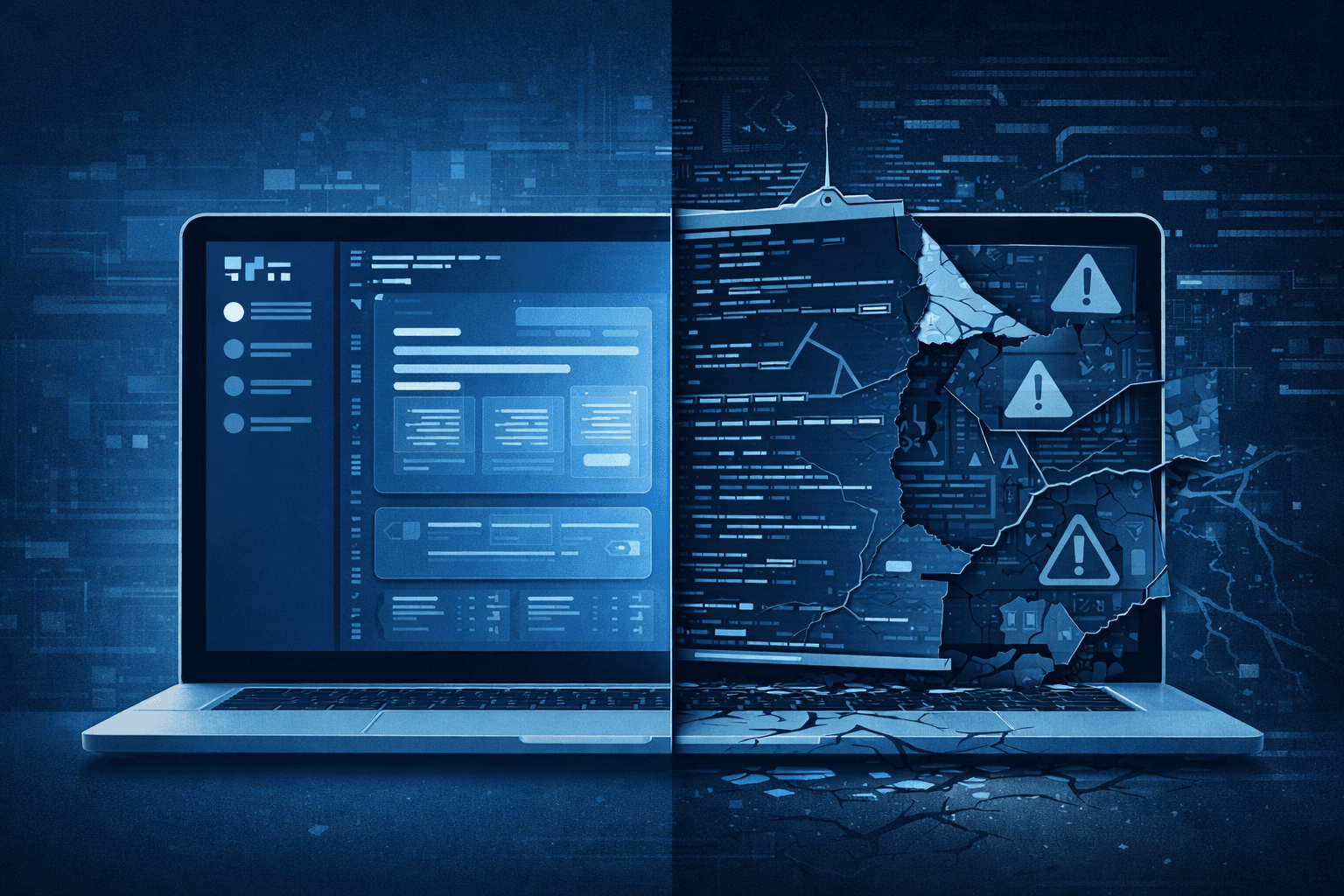
I was building a document analysis app and decided to lean into vibe coding — let the AI take the lead, minimal steering from me. The result looked impressive. The UI was clean, the core flow worked, and if you ran through the happy path, you'd think the app was ready to ship.
Then I tried the edge cases. Documents in unexpected formats. Unusual input sequences. The kind of thing real users do without thinking. The app started breaking.
When I looked under the hood, the code had repetitions, inefficient patterns, and integration decisions that didn't match how I'd normally structure things — particularly around how the app used the Garchi CMS API. It could have been done better. And it was, once I gave the AI concrete examples, set clearer technical expectations, and refined the output against what I knew the architecture needed. I also had to write parts of it manually to make it a solid product.
That's the gap in one story. The AI got me to 70% fast. But the last 30% — the part that makes software actually reliable — needed someone who understood the code, the product, and the constraints. To be honest, I would say the last 30% was something that could make 70% impact.
Why expertise matters more now, not less
AI tools don't make expertise less valuable. They make it more leveraged.
An experienced user is better at every step that matters: giving well-scoped instructions instead of vague prompts, spotting when the AI solved a slightly different problem than the real one, catching hidden risks like security holes or scalability issues, validating whether the output solves the actual business problem, and deciding what should be automated versus what needs human care.
Recent research backs this up. An Anthropic study found that developers using AI while learning a new coding skill scored significantly lower on a follow-up assessment, while the productivity gains were small and not statistically significant. The tool helped them produce output. It didn't help them understand what they were producing.
The output isn't understandable. And without understanding, you can't make good decisions.
The same tool, two very different results
The inexperienced user asks for a feature, gets code, and assumes it works because it runs. Doesn't check edge cases, doesn't consider how it interacts with the existing system, doesn't think about what happens at scale or when inputs get messy. Ships it. Looks great in the demo. Then reality hits.
The experienced user gives context first, narrows the task, reviews critically, tests edge cases and questions assumptions. Uses the tool as leverage — not as the final authority.
Same tool but wildly different outcomes.
Vibe coding has its place. Production is not that place.
I've written about vibe coding before. It's useful for exploration, rough prototypes, internal tools, and learning.
It becomes dangerous when people confuse a working demo with a production-ready system. A demo that impresses on screen can be a maintenance disaster underneath — hardcoded values, no error handling, no thought about failure modes, no path to scale.
What AI can and can't replace
AI meaningfully reduces effort in repetitive tasks, boilerplate, first-pass implementation, initial debugging, test writing, documentation, and codebase exploration.
AI does not necessarily replace responsibility for architecture, system design, business logic validation, production reliability, security, performance tradeoffs, maintainability, and product judgment. Yes, the tools will improve. But in my view, they will still remain tools, not owners of outcomes.
The first list is execution speed. The second is decision quality. AI handles the first well. The second is still on you.
What this means if you're a founder
You now have more capability at your fingertips than at any point in history. You can validate ideas faster, prototype sooner, and iterate more cheaply. That's genuinely exciting.
AI can help you build faster, but it can also help you build the wrong thing faster. It can make bad architecture look like progress. It can produce code that works today and becomes unmanageable in three months. It can give you a demo that impresses the room while hiding problems that will be expensive to fix.
The question isn't whether to use AI tools. You should. The question is whether you can tell the difference between good output and output that merely looks good.
So what's the answer?
Sometimes the right move is to learn enough yourself to guide the tool well. Understand the basics, ask the AI to explain its choices, and build your own judgment over time.
Sometimes the right move is to bring in someone who can review, structure, and validate the work before bad decisions compound — someone who knows the gap between "it runs" and "it's ready."
Either path works, assuming the tool alone will handle it does not.
AI coding tools don't eliminate the need for expertise. They make expertise more leveraged.
The winners won't be the people with access to the best tools — everyone has access now. The winners will be the people who know how to use them with judgment.
I'm Aditya Kadam, Founder of LumenHarbor Digital Solutions. We help non-technical founders and early-stage teams build software that actually works — not just software that demos well. If you're using AI tools to build your product and want an experienced set of eyes on it, let's talk.
Follow this newsletter for honest takes on shipping real software. No hype. No doom. Just what works.